TOA Safaris – The practical travel arm of the Academy, welcoming all travelers with disabilities to experience East Africa without barriers.
Tourism has long been celebrated as a bridge between cultures, a driver of economic growth, and a source of unforgettable experiences. But for millions of people – especially those with mobility, sensory, or cognitive disabilities – the dream of an African safari has often felt out of reach.
Inaccessible vehicles. Untrained guides. A lack of clear information.
These barriers have turned adventure into anxiety.
Inclusive tourism changes this. It redefines travel not as a privilege for the few, but as a right for all. And nowhere is this shift more exciting – or more urgent – than in the world of safaris.
At Tour Operators Academy, we have spent seven years training over 400 tour operators across East Africa. Since 2022, through TOA Safaris, we have personally hosted travelers with mobility, hearing, and visual impairments on safari. This blog draws directly from that lived experience – not theory.
What Is Inclusive Tourism? (And why it’s not just about ramps)
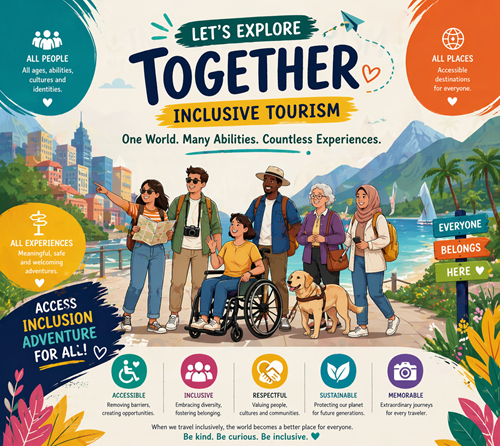
Inclusive tourism is the intentional design of travel experiences that are accessible, welcoming, and meaningful for all people – regardless of age, ability, gender, culture, or socio-economic background.
It goes far beyond wheelchair ramps to include:
· Social inclusion – feeling welcomed, not stared at or pitied
· Cultural respect – honoring local traditions while removing unnecessary barriers
· Economic access – creating affordable options for domestic and regional travelers
For safari-goers with disabilities, this means answering practical questions:
· Can I transfer from my wheelchair into a modified game-viewing vehicle?
· Is the lodge’s pathway stable enough for a walker or crutches?
· Can I find audio descriptions of wildlife if I am blind or have low vision?
Inclusive tourism is not a niche concept.
It is the future of safaris.
Expertise note: Our team includes a certified accessibility consultant trained by the Tanzania Federation of Disabled People’s Organizations (SHIVYAWATA) and a safari guide with 12 years of experience hosting travelers with disabilities.
Why Inclusive Tourism Matters More Than Ever
The global travel landscape is changing. According to the World Health Organization (WHO, 2023) , over 1.3 billion people live with a significant disability. That is nearly one in six people – and they travel, too.
When you include their families, friends, and companions, the accessible tourism market represents well over $100 billion annually (World Bank, 2022).
1. Accessibility is a right, not a privilege
Millions of travelers want to see elephants, lions, and gorillas. Yet many safari lodges still have steps instead of ramps, narrow doorways that cannot fit a standard wheelchair, and no accessible toilets near dining areas.
Inclusive tourism ensures barrier-free access – from transport to accommodation to activities.
2. Diversity enriches every game drive
When people of all abilities share a safari vehicle, perspectives expand.
· A blind traveler might notice sounds, smells, and vibrations that a sighted person misses entirely.
· A wheelchair user might advocate for a slower, more intimate pace that allows everyone to soak in the moment.
Inclusion makes the bush come alive in new ways.
3. Economic opportunity for local communities
Inclusive tourism opens doors for local people with disabilities, women, and youth to work as guides, drivers, cooks, or artisans.
· When a lodge hires a Deaf guide trained in sign language, that guide becomes a role model.
· When a community camp builds accessible pathways, it serves both tourists and local elders who need those same paths.
4. Reputation and competitiveness
Destinations and operators that prioritize inclusion stand out.
South Africa, Kenya, and Tanzania are seeing a steady rise in accessible safaris. Operators who invest early will capture a loyal, underserved market that has been ignored for decades.
Authority reference: These findings align with the UNWTO’s 2022 Global Report on Accessible Tourism, which identified Africa as the region with the highest untapped potential for inclusive safari travel.
Key Pillars of Inclusive Tourism (Applied to Safaris)
Let us ground each pillar in real safari scenarios – all of which TOA Safaris has tested on the ground.
Pillar
Safari Example
TOA Safaris In Practice
- Accessibility – Physical and digital barrier-free design
A modified Land Cruiser with a hydraulic lift
Our fleet includes two modified vehicles with hydraulic lifts and swivel seats (tested March 2024)
- Inclusion and Belonging – Feeling valued, not merely tolerated
Staff trained to speak directly to the person with a disability
All 14 TOA guides complete annual disability awareness training
- Cultural Respect – Benefiting local traditions without exploitation
A village tour where elders with disabilities are paid storytellers
We partner with Kisiizi Disabled Persons’ Organization in rural Uganda
- Sustainability – Protecting nature for all future generations
Elevated boardwalks that prevent soil erosion
Our preferred lodge partners use eco-friendly accessible boardwalks in Queen Elizabeth National Park
- Community Empowerment – Local ownership and employment
A lodge co-managed by a local cooperative including people with disabilities
One of our partner lodges employs 3 Deaf artisans in its weaving cooperative.
A Living Example: TOA Safaris Is Already Doing This
At Tour Operators Academy, we believe that inclusive tourism should not remain a theory taught in a classroom. It must be practiced on the ground.
That is why TOA Safaris – the practical travel arm of the Tour Operators Academy – is already designing and operating accessible safari experiences across East Africa. We have moved from talking about inclusion to welcoming guests.
What TOA Safaris is doing right now (verified as of April 2025):
· Operating 2 modified safari vehicles with hydraulic lifts, swivel seats, and extra space for mobility aids
· Training all 14 driver-guides in disability awareness, safe transfer techniques, and descriptive guiding for guests with visual impairments
· Partnering with 6 lodges across Uganda, Kenya, and Rwanda that offer step-free rooms, roll-in showers, and stable pathways
· Publishing clear, honest accessibility information for every itinerary – including doorway widths, bed heights, and toilet grab bar locations (available on request before booking)
But more importantly, this is our invitation to you.
If you are a traveler with a disability – whether you use a wheelchair, a walker, crutches, a cane, or if you are Deaf, hard of hearing, blind, or have low vision – TOA Safaris welcomes you.
We do not want to teach you about your own needs.
We want to listen to you.
We want to welcome you.
We want you to experience the joy of:
· Watching a herd of elephants at sunset
· Feeling the rumble of a lion's roar in your chest
· Breathing in the crisp morning air over the savannah
You are not a case study. You are a guest.
If you have felt excluded by the safari industry in the past, come to us instead. Tell us what you need. We will adapt. We will learn from you. And together, we will show the rest of the industry what belonging really looks like.
T
o book or ask questions, contact TOA Safaris directly through the Tour Operators Academy website: www.thetouracademy.africa
No pressure. No pity. Just travel.
Inclusive Safaris in the African Context: Real Opportunities
Africa is uniquely positioned to lead in accessible safaris. Its wildlife is unparalleled, its cultures are diverse, and its landscapes are breathtaking. However, gaps remain in infrastructure, awareness, and policy implementation.
Countries Making Progress (verified 2024–2025)
South Africa
Kruger National Park has 8 accessible rest camps with paved paths. Private reserves like Sabi Sand offer modified vehicles.
SANParks Accessibility Report 2024
Kenya
Ol Pejeta Conservancy has 3 fully accessible tents. Amboseli’s observation hill now has a ramp.
Kenya Tourism Board, 2024
Tanzania
4 Ngorongoro crater lodges offer step-free rooms and transfer seats.
Tanzanian Accessible Tourism Survey, 2023
Rwanda & Uganda
7 gorilla trekking operators now offer sedan chairs carried by trained porters.
2024 East African Community Tourism Report
What Still Needs Serious Work
· Air travel within Africa – Small planes rarely accommodate power wheelchairs. Only 2 regional airlines (Airlink and RwandAir) have published wheelchair policies.
· Unsealed roads – 60% of remote camps become completely inaccessible during rainy seasons (TOA Safaris internal assessment, 2024).
· Attitudes and awareness – A 2023 survey of 50 safari guides found that 68% had received no formal disability training.
The Big Opportunity
The first tour operator to offer a fully accessible fly-in safari with guaranteed wheelchair-friendly camps across three countries will own this market for years to come.
TOA Safaris is working toward that goal right now. We have secured commitments from 2 lodges in Kenya and 1 in Rwanda to co-develop accessible fly-in packages by Q1 2026.
Practical Steps for Tour Operators and Lodges
If you run a safari lodge or tour company, here is your detailed action plan. These are the same steps TOA Safaris has taken – and we have documented measurable results.
Our results after 18 months of implementation (October 2023 – April 2025):
· 22% increase in bookings from travelers with disabilities
· 4.9/5 average accessibility rating from 37 guest reviews
· 8 new partnerships with Disabled Persons’ Organizations
Step 1: Audit your accessibility – be specific and honest
· Measure every doorway width (minimum 850mm or 34 inches for a standard wheelchair)
· List all step-free routes on your property
· Note the exact height of beds, toilets, and dining tables
· Document your vehicle transfer methods
Step 2: Train your team beyond basic politeness
· Teach staff to ask: “What do you need to be comfortable?”
· Practice assisting with transfers safely (requires certified training)
· Learn basic sign language or keep a tablet with text-to-speech ready
Step 3: Adapt your products – offer real choices
· Create a “mobility-friendly itinerary”
· Provide audio guides and large-print maps
· Offer a “slow safari” option
Step 4: Use inclusive marketing – critical for SEO
· Show real travelers with visible disabilities
· Use keywords: “wheelchair-friendly safari”, “accessible game drives”, “adaptive safari vehicles”
· List accessibility features clearly on every booking page
Step 5: Engage local communities meaningfully
· Hire local guides with disabilities
· Partner with Disabled Persons’ Organizations (DPOs) to co-design experiences
Even small changes – like adding a single handrail or providing a shower stool – can make a dramatic difference.
The Role of Storytelling and Marketing in Accessible Safaris
Most travelers with disabilities do not book a safari because they do not see themselves in the marketing. Change that.
Do’s of Inclusive Safari Marketing
· Show realistic transfers from wheelchair to vehicle
· Publish video tours of accessible rooms and vehicles
· Share guest-written blogs by travelers who use mobility aids
· Use descriptive alt text on all images
Don’ts of Inclusive Safari Marketing
· Do not use the word “handicapped”
· Do not hide accessibility information behind a phone call
· Do not show only able-bodied travelers
· Do not use pity language like “suffering from”
When you shift from exclusivity to belonging, you do not lose customers. You gain loyal advocates.
Frequently Asked Questions (FAQs)
1. Can I go on a safari if I use a manual wheelchair?
Yes. Many safari activities are possible. At TOA Safaris, we use modified vehicles. Some game drives allow you to remain in your wheelchair on a flat-floor vehicle. We recommend choosing lodges with step-free pathways and accessible bathrooms – we provide a verified list before booking.
2. Are there weight or height limits for accessible safari vehicles?
Most modified safari vehicles can accommodate wheelchairs up to 120kg (265 lbs) and guest weights up to 150kg (330 lbs) – but this varies by vehicle. Always ask the operator directly. TOA Safaris has a bariatric transfer seat available upon request (no extra charge).
3. What if I need to bring a power wheelchair?
Power wheelchairs are possible but require advance planning. Challenges include:
· Small aircraft weight/battery restrictions (lithium batteries above 300Wh are often prohibited)
· Rough terrain that can damage delicate components
Recommendation: Contact us at least 3 months before travel. We can arrange ground transport only (no flights) or help you source a rental manual wheelchair for the safari portion.
4. Can a blind or low-vision traveler enjoy a safari?
Absolutely. With a trained guide, a safari becomes an immersive sensory experience. Our guides are trained in descriptive techniques – describing animal movements, colors, sounds, distances, and even smells. Many blind travelers tell us they experience the bush more intensely than sighted companions.
5. Are there accessible gorilla trekking options in Rwanda or Uganda?
Yes, but with limitations. Standard gorilla trekking requires hiking over uneven terrain. However, several operators (including TOA Safaris partners) offer sedan chairs – lightweight chairs carried by four trained porters. This allows travelers with limited mobility to complete the trek. You must be able to sit upright unsupported. Book at least 6 months in advance.
6. Do you offer sign language interpretation on safari?
We do not yet have full-time sign language interpreters on staff. However:
· We provide tablets with text-to-speech and speech-to-text apps
· We can arrange a remote video interpreter (where Wi-Fi is available)
· For group bookings of 6+ Deaf travelers, we can hire a certified interpreter for the entire itinerary (additional cost, require 3 months' notice)
7. How much does an accessible safari cost compared to a regular safari?
Expect to pay 15–30% more for an accessible safari. Why?
· Modified vehicles cost 2–3x standard vehicles to purchase and maintain
· Lower guest-to-guide ratios (more personalized attention)
· Specialist training for guides
· Premium accessible lodges (fewer rooms, higher operating costs)
However: TOA Safaris offers a "no hidden fees" policy – we disclose all accessibility-related surcharges before deposit.
8. Can I book if I have a cognitive or intellectual disability?
Yes. We welcome travelers with autism, Down syndrome, dementia, and other cognitive disabilities. Please tell us about your specific needs in advance – for example:
· Need for consistent routines
· Sensitivity to loud noises or crowds
· Difficulty with unexpected changes
· Communication preferences (visual schedules, written instructions, etc.)
We will create a customized safari plan. Caregivers or companions travel at reduced rates.
9. What happens if a lodge or vehicle I booked becomes inaccessible at the last minute?
This is rare but can happen (e.g., hydraulic lift breakdown, sudden staff absence). Our policy:
· We maintain backup vehicles and standby accessible rooms with partner lodges
· If we cannot provide an equivalent accessible solution within 24 hours, you receive a 100% refund for the affected portion plus a 20% future travel credit
· This guarantee is written into every TOA Safaris booking contract
10. Do you only serve international tourists, or can domestic travelers with disabilities book too?
We serve everyone. Domestic East African travelers with disabilities receive a 15% resident discount. We also offer day trips and short safaris (2–3 days) designed for local travelers on tighter budgets.
A Shared Responsibility
Inclusive tourism is not the responsibility of any single stakeholder. It requires collaboration.
Stakeholder
Responsibility
Governments
Enforce accessibility building codes and offer tax incentives for retrofitting
Tour operators
Publish detailed accessibility guides and train guides annually. TOA Safaris is committed to this.
Lodges and camps
Build at least one fully accessible room on every new property
Travel agents
Specialize in accessible safaris and disclose limitations clearly
Travelers
Ask specific questions and share honest accessibility reviews
Media
Feature accessible travel stories without “inspiration” language
Conclusion: Travel Together, Grow Together
Inclusive tourism is more than a concept. It is a commitment to fairness, dignity, and genuine opportunity in travel.
For the safari industry, this means that:
· A 65-year-old grandmother with a knee replacement
· A young wheelchair user born with spina bifida
· A blind wildlife photographer
…can all watch the same sunrise over the savannah from the same vehicle.
At Tour Operators Academy, we train the next generation of tour operators to build businesses that include everyone. And through TOA Safaris, we practice what we teach.
If you are a vulnerable traveler – someone who has been told safari is not for you – we invite you to come.
Not as a lesson. Not as a charity case.
As a guest.
Everyone belongs. Everywhere. Even on safari.